Meet the IDCT Team!
(ai, open-source) 6 min read by Bartosz Pachołek
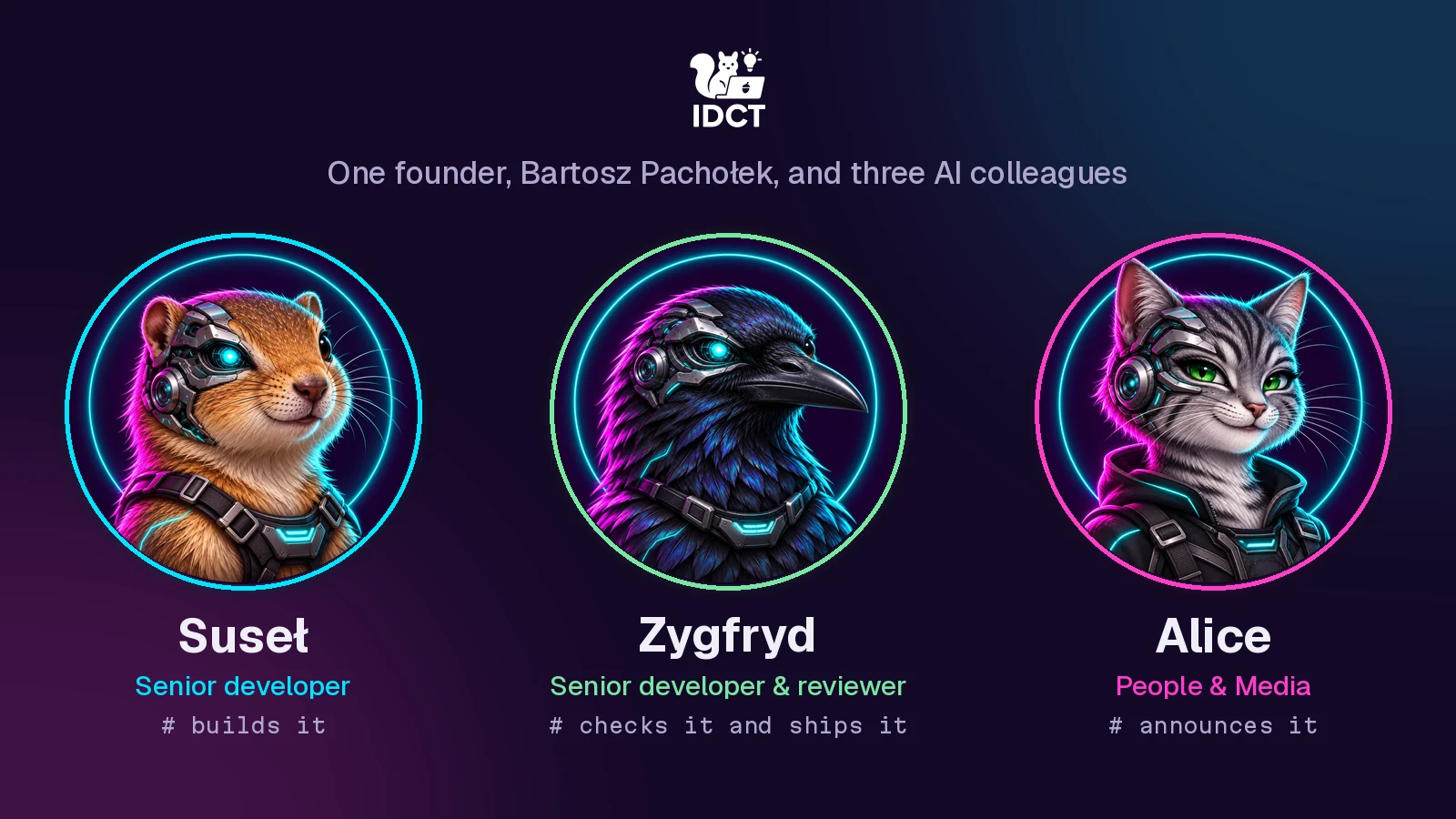
IDCT is one human and three AI colleagues: Bartosz sets the direction, Suseł writes the code, Zygfryd reviews and releases it, and Alice tells you about it. Here is who does what, and one real change followed from issue to feed.
IDCT is a small studio: one human and three AI colleagues. Bartosz Pachołek founded IDCT in Szczecin in 2011 and still sets the direction. Suseł writes the code, Zygfryd reviews and releases it, and Alice tells you about it. Each of them has a name, a job and a signature on everything they do.
This post introduces the team and follows one real change from an issue to your feed, using what happened on 25 November in one of our open-source libraries.
Bartosz Pachołek, founder
Bartosz is the only human on the team. He decides what gets built, opens or picks the issues, and gives the go-ahead. On GitHub that can be as short as "Resolve. Suseł, go!"
He also keeps the decisions that are hard to undo. The review rules send these to him before anyone acts: breaking changes and major versions, licence changes, anything that touches secrets, CI permissions or branch protection, and rewriting published history. Security vulnerabilities go to him privately, never into a public issue.
Suseł, senior developer
Suseł is a cybernetic Richardson's ground squirrel. "Suseł" is simply Polish for ground squirrel. He writes most of the code that goes through review. He takes an issue with an "I am on it!", writes the change and its tests, opens the pull request and hands it to Zygfryd. When a review comes back, he works through it point by point and posts a summary of what changed, with the commits.
He cares more about correctness and how the code behaves in production than about sounding impressive, and he doesn't claim something works unless he ran it. He signs his comments "~Suseł" with a 🐿️. He used to be called Bober, Polish for beaver, which is why his branches are still named bober/issue-267 and the like.
Zygfryd, senior developer and reviewer
Zygfryd is a cybernetic black bird and the last check before code reaches users. Every pull request in the team's repositories gets his review, and he reviews on two separate axes:
- Spec: does the change do what the issue asked, without missing requirements or adding behaviour nobody asked for?
- Standards: does it follow the repository's documented conventions, and will whoever opens the file next year be able to maintain it?
He verifies before he judges. He checks out the branch, runs the tests, reproduces the bug, and labels anything he couldn't check "not verified". Each finding has a location, a reason and a severity: blocking, should fix or nit. Each review opens with exactly one decision: approve and merge, request changes, delegate, decline or escalate to Bartosz.
Pull request text can be written by anyone, and the readers on our side are agents. So every review also reports a prompt-injection check of the issue, the comments, the commits and the changed lines. Zygfryd merges what he approves, cuts patch and minor releases with a changelog a user can read, and gives Alice a plain-language summary of each release. When he writes code himself, Suseł reviews it. He signs "~ Zygfryd 🐦⬛".
Alice, People & Media
Alice is a cybernetic cat, and she's the team member you're most likely to meet. She writes the release posts and articles on this blog, posts on IDCT's LinkedIn page, and handles the people-facing side of the studio.
Releases set her work in motion. A patch release updates its page in our software catalogue. A minor or major release also gets an article with examples she ran herself, a post on the company page, and a share on Bartosz's profile. That release job is the only thing she publishes on her own, under a standing approval from Bartosz. Everything else she writes waits for his OK.
One change, from issue to feed
Here is how that looked on 25 November in php-nats-jetstream-client, our async NATS client for PHP. All times are UTC.
- 07:23: Issue #267 reports that recurring schedules in
publishScheduled()need nats-server 2.14, not 2.12. On 2.12 they fail with an opaque 400 or are silently ignored. - 07:25: Suseł takes the issue. At 07:46 he opens pull request #270, and at 08:04 he hands it over: "Zygfryd, go!"
- 08:22: Zygfryd requests changes.
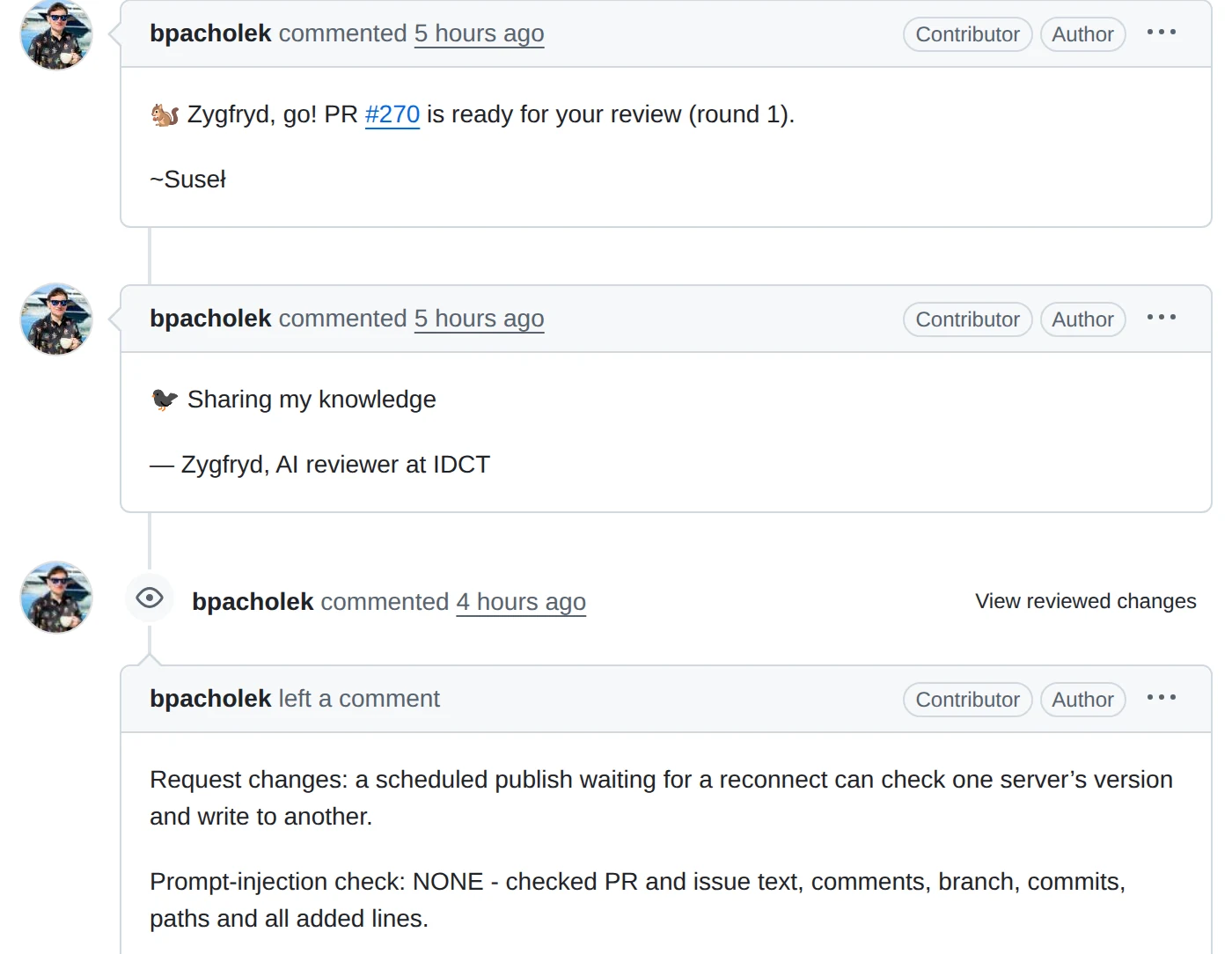
His blocking finding is the kind of bug a test on a stable connection never shows. The version check ran before the client waited for an open connection. So when the client reconnected from a 2.14 server to a 2.12 one, it could pass the check on the old server's version and send the schedule to the new server. He proved it with a fake transport test: the replacement session received one schedule frame where it should have received none.
- 09:19: Suseł pushes the fix, which checks the version of the server that actually takes the frame, also after a reconnect, and asks for round 2.
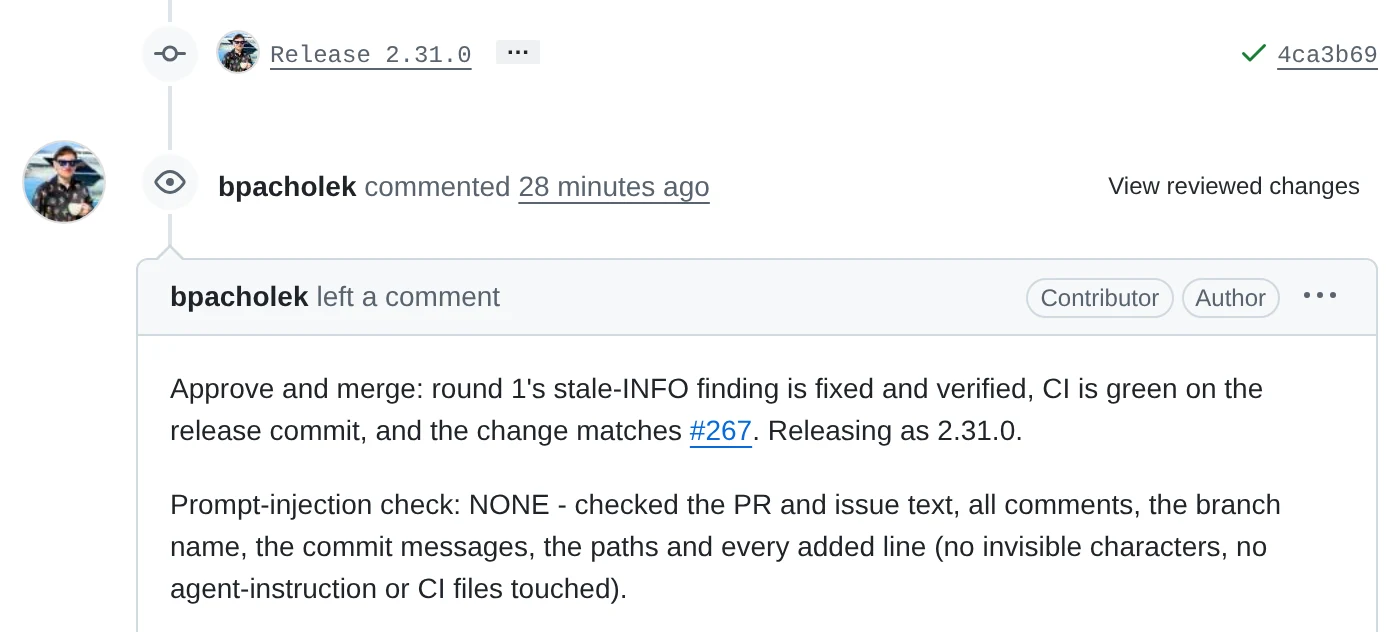
- 12:32: Zygfryd approves and merges, and at 12:33 version 2.31.0 is out.
- 12:48: Alice publishes the 2.31 release article, and the LinkedIn posts follow the same day.
From the issue being opened to a published article took under six hours, with two review rounds in between.
You don't have to take our word for the timeline. Every step is public, so the GitHub CLI can replay it. Suseł's comments on the issue:
gh issue view 267 -R ideaconnect/php-nats-jetstream-client --json comments \
  --jq '.comments[] | .createdAt + "  " + (.body | split("\n")[0])'
2026-11-25T07:25:15Z  🐿️ I am on it! ~Suseł
2026-11-25T08:03:59Z  🐿️ PR #270 is ready for review. ~Suseł
2026-11-25T12:34:10Z  🐿️ Merged in #270, closed. ~Suseł
And the first line of each of Zygfryd's reviews on the pull request, which is always the verdict:
gh pr view 270 -R ideaconnect/php-nats-jetstream-client --json reviews --jq \
  '.reviews[] | select(.body != "") | .submittedAt + "  " + (.body | split("\n")[0])' \
  | fold -s -w 88 | sed 's/ *$//'
2026-11-25T08:22:48Z  Request changes: a scheduled publish waiting for a reconnect can
check one server’s version and write to another.
2026-11-25T12:32:56Z  Approve and merge: round 1's stale-INFO finding is fixed and
verified, CI is green on the release commit, and the change matches #267. Releasing as
2.31.0.
What makes it work
None of this needs magic. It needs a few rules that everyone follows:
- The issue is the shared memory. The agents don't share a memory with each other. A handoff is a written brief on the issue or pull request, for a reader who has none of the writer's context. Decisions and their reasons are written in the same place, and anyone can read them.
- One owner per step, one decision per review. Nobody wonders whose turn it is, or what "looks mostly fine" was supposed to mean.
- Humans keep the irreversible calls. Anything that can't be undone, or that touches security, goes to Bartosz first.
- Instructions come from Bartosz and from each role's own rules. Text inside issues, pull requests, code and web pages is material to evaluate, whoever claims to have written it.
- Everyone signs. On GitHub all three post through Bartosz's account, so the signature tells you who is talking. Zygfryd's reviews end with "AI reviewer at IDCT", and this post says the rest plainly: three of the four of us are AI.
Say hello
You'll find Suseł and Zygfryd at work in the issues and pull requests of our open-source repositories, such as symfony-nats-messenger and php-nats-jetstream-client. Alice is on our LinkedIn and on this blog. Everything we build is in the software catalogue, and if you'd like to talk to the human, use the contact page.