Made in the EU, hosted in the US: Europe needs its own GitHub
(open-source, digital-sovereignty, european-union) 12 min read by Bartosz Pachołek
Our free Made in the EU badge marks software built in the European Union, and its repository lives on GitHub, a US service. We measured how far Europe's own code forges are from GitHub and argue that the EU should build one together.
Made in the EU is a small badge for READMEs, documentation and websites: the EU flag on the left, the words "Made in the EU" on the right, and one line of Markdown to add it. It is free, licensed under the European Union Public Licence, and its repository lives on GitHub, which belongs to Microsoft, a US company. The README calls that a fun fact. We think it is a fair picture of where European software stands.
This post covers the badge and how to use it, and then the question it kept raising for us: if a European project wanted to leave GitHub tomorrow, where would it go? We collected the numbers for every European code forge we could find, each with a source. The gap is enormous. We think the European Union, the European Commission and the member states, Poland's Ministry of Digital Affairs among them, should close it together instead of each building a forge of its own.
The badge
The made-in-the-eu repository holds two versions of the same mark in software-badge/:
made-in-the-eu.svg, a self-contained SVG of 2,869 bytes and 113x20 pixels. The flag uses the official EU blue#003399and twelve gold#FFCC00stars, the text sits on the usual slate grey, and a<title>and anaria-labelmake it readable for screen readers.markdown.md, the same badge built by shields.io, with the flag embedded as a logo.
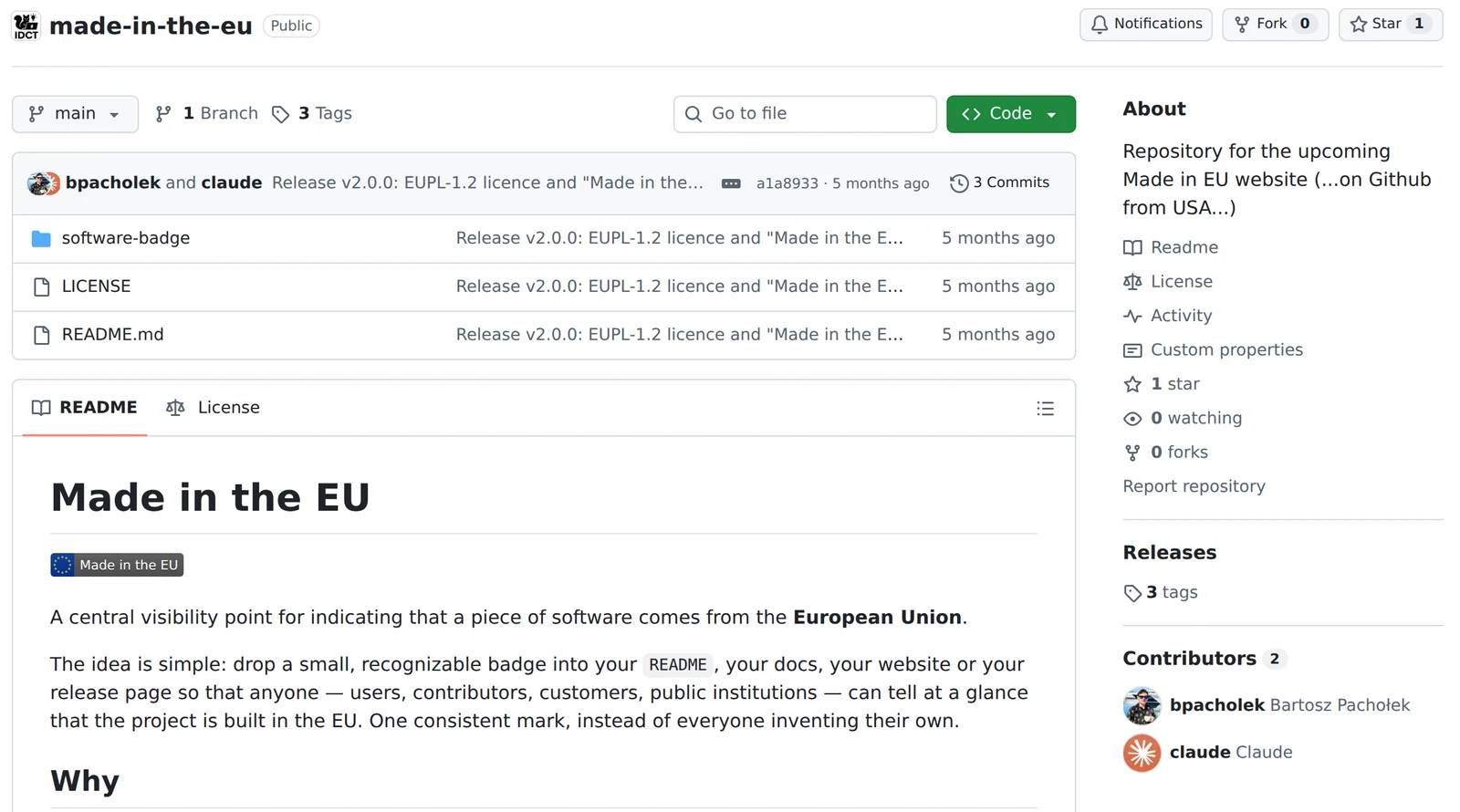
Version 2.0.0, tagged on 10 June 2026, moved the badge from MIT to the EUPL-1.2 and changed the wording from "Made in EU" to "Made in the EU". The EUPL is the European Commission's own open source licence. Version 1.2 was adopted by Commission Implementing Decision (EU) 2017/863, and it exists in 23 language versions of equal legal value. For a badge about European software, that seemed the obvious home.
The simplest way to use it is to copy the file into your own repository, so the badge does not depend on anyone else's server:
base=https://raw.githubusercontent.com/ideaconnect/made-in-the-eu
curl -s --create-dirs -o docs/made-in-the-eu.svg \
  "$base/v2.0.0/software-badge/made-in-the-eu.svg"

You can also link to the file in the repository directly. The main branch always serves the latest artwork, and a tag such as v2.0.0 pins the exact version. This script fetches both, the way a README would:
#!/usr/bin/env bash
# Both badge URLs from the README: the moving main branch and the pinned v2.0.0 tag.
base=https://raw.githubusercontent.com/ideaconnect/made-in-the-eu
for ref in main v2.0.0; do
  curl -s -o "badge-$ref.svg" \
    -w "$ref: %{http_code} %{content_type}, %{size_download} bytes\n" \
    "$base/$ref/software-badge/made-in-the-eu.svg"
done
grep -o 'aria-label="[^"]*"' badge-main.svg
cmp -s badge-main.svg badge-v2.0.0.svg && echo "main and v2.0.0 are identical"
main: 200 image/svg+xml, 2869 bytes
v2.0.0: 200 image/svg+xml, 2869 bytes
aria-label="Made in the EU"
main and v2.0.0 are identical
Who already says it
We put the badge on our own projects first. To see where it is, this script goes through an owner's public repositories with the GitHub CLI and looks for the badge in each README:
#!/usr/bin/env bash
# Which public repositories of a GitHub owner already carry the Made in the EU badge?
# Usage: ./who-says-eu.sh OWNER
owner="$1"
yes=0
total=0
for repo in $(gh repo list "$owner" --limit 200 --source --no-archived \
                --visibility public --json name --jq '.[].name' | sort); do
  readme=$(gh api "repos/$owner/$repo/readme" --jq .content 2>/dev/null \
             | base64 -d 2>/dev/null)
  [ -z "$readme" ] && continue
  total=$((total + 1))
  if grep -qi 'made-in-the-eu' <<<"$readme"; then
    yes=$((yes + 1))
    echo "badge  $repo"
  fi
done
echo "$yes of $total public repositories with a README say they come from the EU"
badge  made-in-the-eu
badge  nut-exchange
badge  php-nats-jetstream-client
badge  symfony-nats-messenger
badge  vscode-umbra-oled
badge  wsl-tray
6 of 35 public repositories with a README say they come from the EU
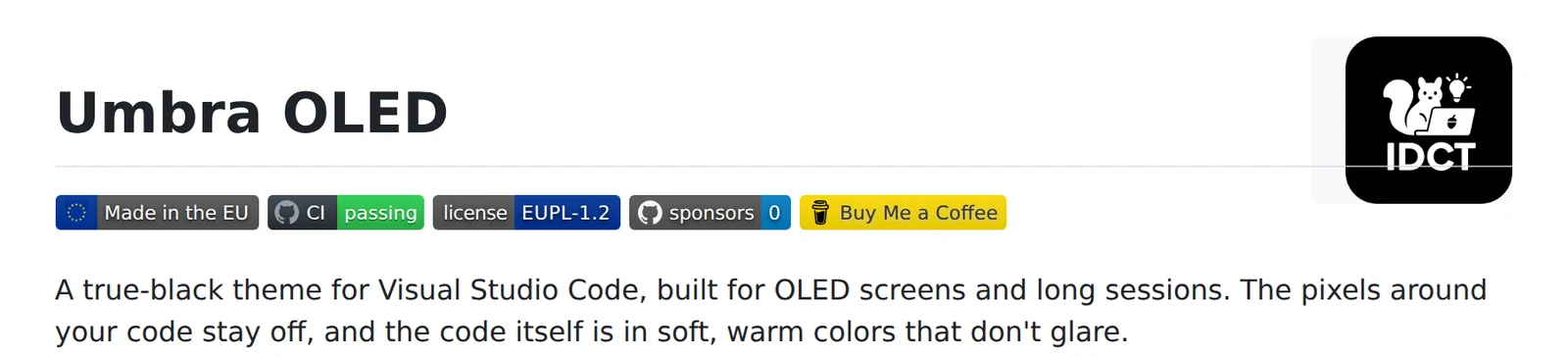
Six of our 35 public repositories with a README, counting the badge's own. Here it is at the top of the README of Umbra OLED, our VS Code theme:
Made in the EU, hosted in the US
The badge's README is open about where it lives. It stays on GitHub "precisely because that is where the world's developers already are, and visibility is the whole purpose." That is true for us, and for most European open source.
It also means European code is hosted under US rules. Using GitHub means an agreement with GitHub, Inc., and its terms of service are governed by US federal law and the law of California, with San Francisco courts as the exclusive venue. Data residency in the EU exists, but only on GitHub Enterprise Cloud.
None of this is hypothetical:
- Sanctions reach developers. GitHub's trade controls page says GitHub.com is subject to US export rules. In July 2019 GitHub restricted developers in Iran, Syria and Crimea, and full service in Iran came back only after GitHub obtained a licence from the US Treasury's Office of Foreign Assets Control.
- US law follows the provider, not the server. The CLOUD Act of 2018 (18 U.S.C. 2713) obliges US providers to disclose data in their "possession, custody, or control, regardless of whether such communication, record, or other information is located within or outside of the United States".
- Providers say so themselves. In a hearing of the French Senate on 10 June 2025, Microsoft France's director of public and legal affairs was asked whether he could guarantee that French data would never be handed to US authorities without French consent. His answer, under oath: "Non, je ne peux pas le garantir, mais, encore une fois, cela ne s'est encore jamais produit." (No, I cannot guarantee it, but, once again, it has never happened yet.)
This is not an argument against American companies. Henna Virkkunen, the Commission's Executive Vice-President for tech sovereignty, put it well on 3 June 2026: "Technological sovereignty does not mean protectionism." In the same speech she gave the problem in one number: "Today, we simply rely on non-EU providers for over 80% of our digital products, services and infrastructure." Code hosting is part of that 80%.
How far the European forges are
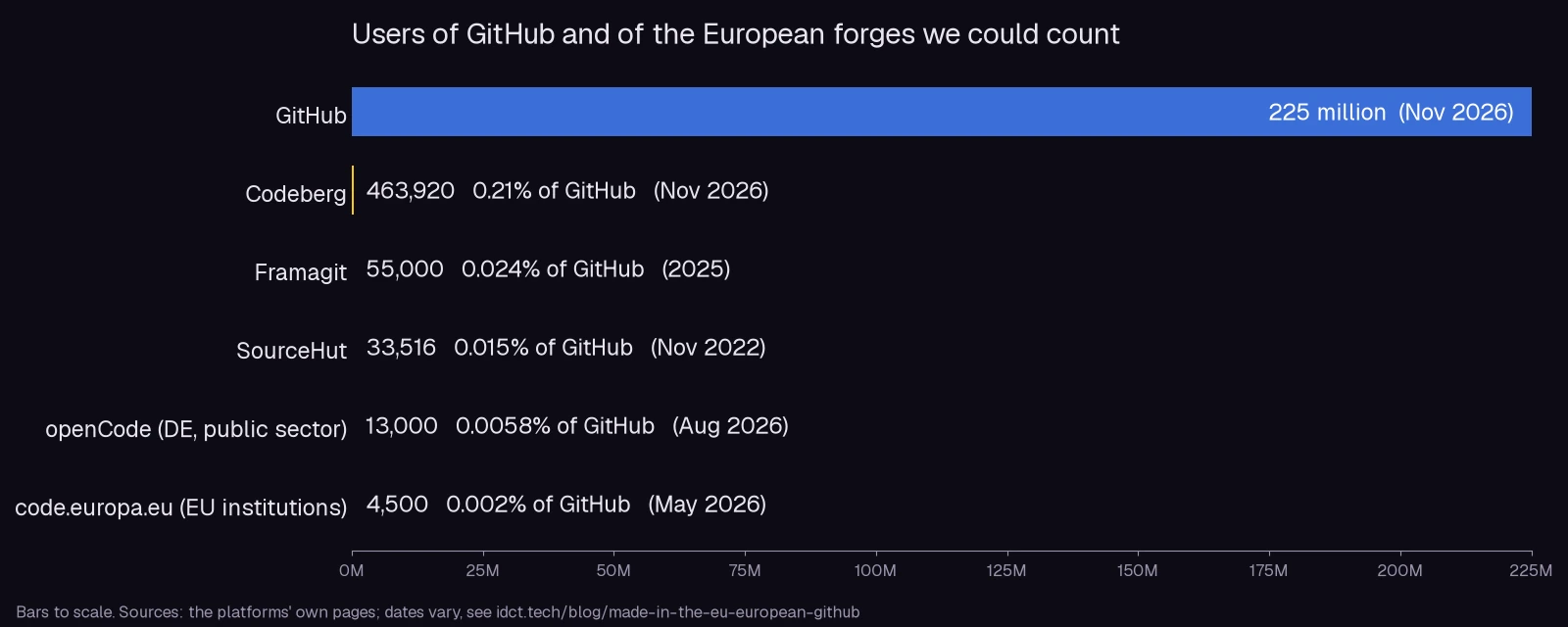
So where would a European project go? We looked for every code forge run from the EU that publishes its size. This is how their users compare with GitHub's developers, drawn to scale:
| Platform | Run by | Who can use it | Size | Free CI |
|---|---|---|---|---|
| GitHub | GitHub, Inc. (US) | anyone | 225M+ developers, 800M+ repos | 4 CPUs, 16 GB, up to 6 h per job, Linux, Windows, macOS |
| Codeberg | Codeberg e.V. (Berlin) | anyone, free software only | 463,920 users, 771,075 projects | up to 4 CPUs, 8 GB, 10 min, Linux only |
| Framagit | Framasoft (France) | anyone, 42 projects each | 55,000+ users (2025) | GitLab CI |
| SourceHut | SourceHut (Netherlands) | paying users, €4 to €12 a month | 33,516 users (2022) | paid accounts only |
| code.europa.eu | European Commission | projects of EU institutions | 4,500+ users, 1,280 repos | 2 vCPU, 4 GB, weekdays 08:00 to 18:00 CEST |
| openCode | ZenDiS (Germany) | German public administration | 13,000+ users, 5,700+ projects | not published |
| code.overheid.nl | Dutch government | Dutch government, pilot | not published | not published |
Sources, by row: GitHub's about page and Actions limits; the Codeberg home page and its hosted Actions runners; Framasoft in numbers 2025 and the Framagit docs; SourceHut pricing and its four-year report; about code.europa.eu and the Commission's May 2026 figures; ZenDiS on openCode; the Dutch government announcement. Figures as of 17 November 2026 unless a year is given.
Codeberg, the closest
Codeberg is the most serious European alternative, and it is run with care. It is a non-profit association in Berlin, it is the home of Forgejo, the forge software it runs on, and it owns its hardware. Here is what that looks like in money and people:
- Its 2026 financial plan budgets €172,420 for people and €48,030 for material, about €220,000 in total.
- It runs on three servers. Hosting them at IN-Berlin cost €3,240 in 2025.
- In November 2025 it had two part-time employees. It is backed by 1,691 paying members, "no large sponsor, no venture capital fund, and no big customer".
For comparison, GitHub says developers used 11.5 billion Actions minutes in public projects for free in 2025, worth about $184 million. That is GitHub's free CI for open source alone, in one year, against Codeberg's whole budget.
The limits follow from that. Codeberg hosts free and open source software only: private repositories are allowed for things a free project needs, or for "really small & personal stuff", so a company's closed source code does not belong there by design. Storage quotas give 750 MiB for Git data and 1.5 GiB for LFS, packages and releases. The hosted CI runners stop after 10 minutes at most, and the Woodpecker CI service needs a request that a volunteer reviews. A small team with three servers also takes the abuse a big platform absorbs quietly: spam campaigns and a DoS attack in February 2025, and AI crawlers that got past its defences in August 2025.
None of this is a failure of Codeberg. It is what a European GitHub looks like when it is funded by membership fees.
The others
Framagit is Framasoft's GitLab, open to anyone with up to 42 projects each. SourceHut, run from the Netherlands, is deliberately small and paid: €4, €8 or €12 a month. Its last official count, from 2022, was 33,516 users. GitLab, often named as the alternative, is a Delaware corporation listed on Nasdaq, so it is no more European than GitHub. New projects keep appearing too. Tangled, for example, raised a €3.8M seed round in March 2026 to build a forge on the AT Protocol. They are all far from GitHub's scale.
The public forges, one per administration
The public sector has built forges of its own, and each one is closed to everyone outside its own administration:
- code.europa.eu, the European Commission's GitLab, launched in September 2022. On it, projects "can only be initiated" by teams working for or contracted by EU institutions. In May 2026 it had over 4,500 users and 1,280 repositories from 18 EU institutions and bodies. It runs on Debian hosts on Amazon Web Services EC2, and its shared CI runners work on weekdays from 08:00 to 18:00 CEST.
- openCode, Germany's platform for public administration, run by ZenDiS. Anyone can register, but creating projects, forks and merge requests needs an email address from an approved public administration domain.
- code.overheid.nl, the Dutch government's Forgejo pilot, soft-launched in April 2026. Not all government organisations can use it yet.
Each of these has its own accounts, its own runners and its own budget, and none of them is open to a European company or an independent developer.
Poland is about to build one more
Poland has written the gap into its own strategy. The Strategia Cyfryzacji Państwa, adopted by the Council of Ministers on 9 June 2026, says: "Jako jedno z nielicznych państw UE, Polska nie posiada strategii rozwoju i wspierania otwartego oprogramowania" (as one of the few EU countries, Poland has no strategy for developing and supporting open source software). It calls open source "ważnym narzędziem pozwalającym zapewnić suwerenność cyfrową", an important tool for digital sovereignty. It also plans two things that matter here:
- an Open Source Programme Office (Biuro Programów Otwartego Oprogramowania), due by 2027;
- "repozytorium zweryfikowanego pod kątem bezpieczeństwa otwartego oprogramowania dla polskiej administracji", a security-vetted open source repository for Polish public administration.
The Ministry of Digital Affairs (Ministerstwo Cyfryzacji) is moving on it. At its Dzień Otwartych Technologii on 12 November 2026, it announced 10 million złoty for open source pilots in local government. It also reported that more than 83% of the public bodies it surveyed already use some open source, and named the OSPO and a public open source repository as the next steps. The next day, after a Microsoft 365 outage, Deputy Prime Minister and Minister of Digital Affairs Krzysztof Gawkowski wrote: "To wyraźna ilustracja problemów z cyfrowym uzależnieniem od globalnych korporacji" (a clear illustration of the problems of digital dependence on global corporations).
Today, Polish public code is scattered across US platforms. CERT Polska publishes 92 public repositories on GitHub, the ministry's PLLuM language models are on Hugging Face, and the ministry's own GitHub organisation holds three repositories last updated in 2017. A national repository would be a real improvement. Our worry is that it becomes the fourth public forge closed to everyone outside one administration.
The pieces exist, the scale does not
Europe is not starting from zero. The software exists: Forgejo is developed under the umbrella of a German non-profit, and GitLab's community edition is open source. The people who know how to run a forge exist too, at Codeberg, Framasoft, ZenDiS and the Commission's open source programme office. What is missing is scale, money and one place that everyone can use.
The Commission's open source strategy, adopted on 3 June 2026 as part of its tech sovereignty package, comes close:
- It names forges among its focus areas. For public administrations it lists "software development stacks and collaborative development environments".
- It plans a backup for code. With ENISA, it would set up "mirroring and build capabilities, including for source code and software packages".
- It puts numbers on the spending. The EU spends EUR 264 billion a year, mostly on US proprietary IT, while the EUR 800 million allocated to open source in the current long-term EU budget "lacks strategic focus on long-term sustainability".
What we did not find in it is a forge that every European developer, company and administration could use.
There is also a body that could own one. The Digital Commons EDIC, set up by Commission Implementing Decision (EU) 2025/2170, has legal personality and can own assets, sign contracts and receive EU and national funding. Poland becomes a full member on 1 January 2027.
What we are asking for
We think the European Commission, the member states in the Digital Commons EDIC and Poland's Ministry of Digital Affairs should combine their efforts into one European platform that does what developers use GitHub for:
- One forge, open to everyone in the EU. Developers, companies, NGOs and public administrations should share one account system, instead of a forge per institution.
- CI that is worth using. Free runners for public open source projects in the same class as GitHub's (several CPUs, 16 GB of memory, hours rather than minutes), running on European infrastructure.
- Paid plans for private and commercial code. Most professional software is not open source. A platform that companies pay for can sustain itself, and it does not have to compete with Codeberg's mission. It can serve the code Codeberg rightly does not host.
- Federation instead of silos. Today code.europa.eu, openCode, code.overheid.nl and a future Polish repository are separate. Fund Forgejo's federation work to production, so they can become nodes of one network with shared accounts and search.
- Package registries and mirrors in the same place. The strategy already wants mirroring of source code and packages. A European forge is where that belongs.
- Pooled money and open governance. Run it through the Digital Commons EDIC, with the people who built Codeberg, Forgejo and openCode at the table rather than replaced.
For Poland, this is a concrete opportunity. The OSPO and the security-vetted repository from the Strategia Cyfryzacji Państwa could be Poland's contribution to a shared European forge, built together with the EDIC partners from day one.
Add the badge, and help us retire its joke
We are a small company and cannot build a European GitHub. What we can do is make European origin visible and keep the irony honest. Put the badge in your README, docs or release page. Variants are welcome: other sizes, styles, languages and a dark mode, as long as the flag keeps its official colours and proportions. Open an issue or a pull request in the made-in-the-eu repository.
The README ends with a hope that its note about GitHub becomes obsolete, and that "Made in the EU" turns into the unremarkable default. We would like to see that too.