
Features
Everything Gentastic does
Built as a focused alternative to node-graph tools - every feature below works from sane defaults, with an optional hint box explaining what each field does.
Generation
Text-to-image
Prompt + negative prompt, seed control, and every advanced slider you'd want - all with working defaults, so you only touch what you want to change.
Image-to-image
Drag & drop an input image, set a denoise strength, and let any supported model reimagine it from your prompt.
Instruction-based editing
FLUX.1 Kontext and FLUX.2 klein editing models take an instruction - "change the suit to grey", "put them on a beach" - and edit the photo while preserving the rest.
Keep-face identity lock
PhotoMaker-based models generate a specific person - from one reference photo - in new scenes, without changing their face. No training, no LoRA to bake.
Per-model resolution presets
Switching models only offers resolutions that actually work well for it - SDXL's native buckets, FLUX's flexible sizes - so you can't accidentally pick a size that distorts the output.
Presets
Save the current prompt and every parameter under a name, and restore the whole setup in one click next time.
Models
One-click model downloads
Pick a model and Gentastic fetches it from Hugging Face with progress, resumable downloads, and license/token gating for restricted models like FLUX.1-dev.
FLUX.1 & FLUX.2 klein
schnell and dev variants, plus the newer, faster FLUX.2 klein (the default - about 4 steps to a finished image).
SDXL & fine-tunes
Photoreal and anime-focused SDXL checkpoints, each with the quality tags they expect applied automatically - you don't need to know what they are or type them yourself.
Quantized GGUF for FLUX
FLUX models ship as GGUF at multiple quantization levels (Q4-Q8, F16) - smaller downloads and predictable memory use. SDXL checkpoints load as single files, as usual for that format.
Model manager
See what's installed, how much disk it uses, download or delete any model - all from one page, with your cache folder configurable in Settings.
Negative prompts that actually work
The negative-prompt box only lights up for models where it does something - so you're never left typing into a field that's silently being ignored.
Runtime & performance
Automatic backend detection
Gentastic probes CUDA, Vulkan, and CPU on first run and picks the fastest one your GPU actually supports - override it any time in Settings.
On-demand CUDA runtime
No CUDA Toolkit on your machine? Gentastic can download a ~570 MB CUDA runtime just for itself - nothing system-wide to install.
Live progress
Per-step progress with a distinct "decoding" phase, plus one-click cancel on any generation.
Out-of-memory guidance
If a generation runs out of VRAM, Gentastic tells you what changed the odds - smaller size, fewer steps, a lower-quant model - instead of a bare stack trace.
Workflow & quality of life
Gallery with real metadata
Every save embeds prompt, negative prompt, model, seed, steps, CFG and sampler directly in the PNG - browse your history and see exactly how each image was made.
Instant thumbnails
A disk-backed thumbnail cache keeps the Gallery snappy even with hundreds of generations.
Built-in field guidance
Every field has an optional hint box explaining what it does, with a concrete example - toggle it off once you know the app.
Dark, Light & System themes
A modern Fluent-style interface (WPF-UI) that follows Windows' theme, or stays fixed to whichever you prefer.
Interface
A real app, not a browser tab
Native WPF, not Electron - the window opens instantly and feels like Windows software because it is Windows software.
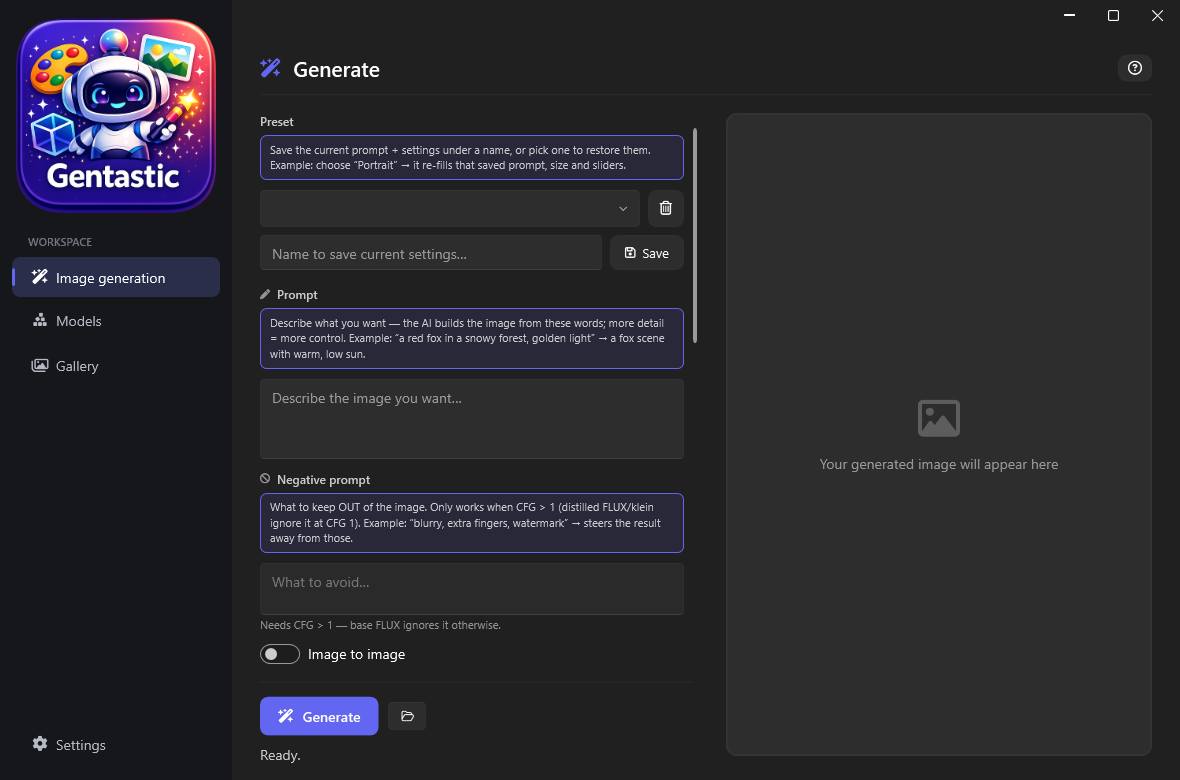
Generate
Prompt, model, size and steps on the left; a live preview on the right. Hint boxes explain every field until you turn them off.
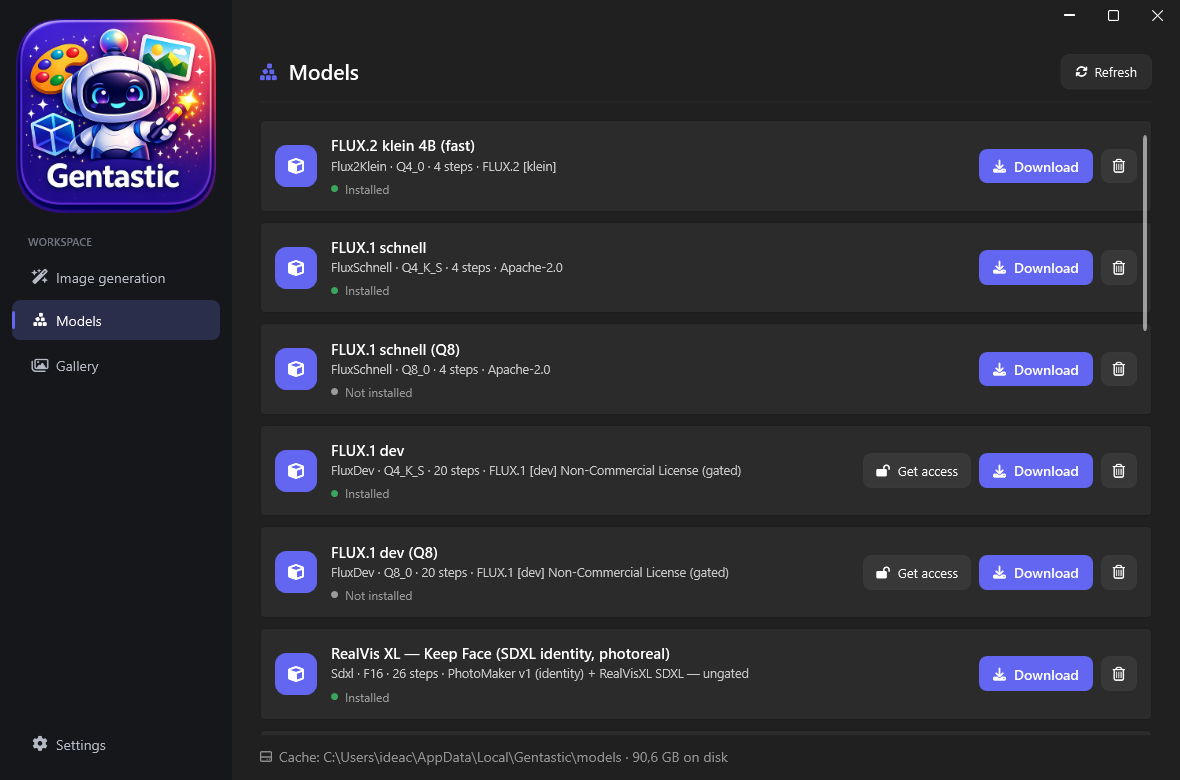
Models
Every model in one list - installed state, quantization, license, and a one-click download or delete.
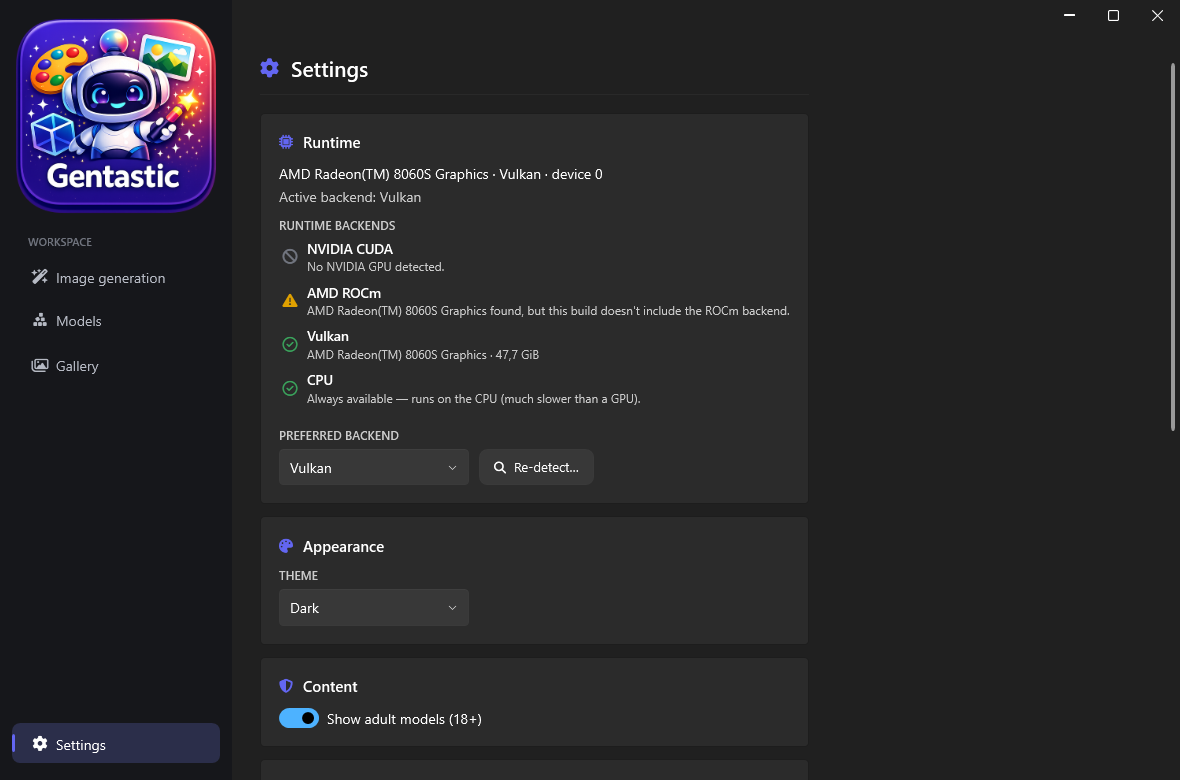
Settings
Runtime backend and detected hardware, cache location, theme, and the adult-content visibility toggle - all in one place.