What Helena does
Features
A full-featured API client in one small native binary - without the browser engine or the lock-in.
Request builder
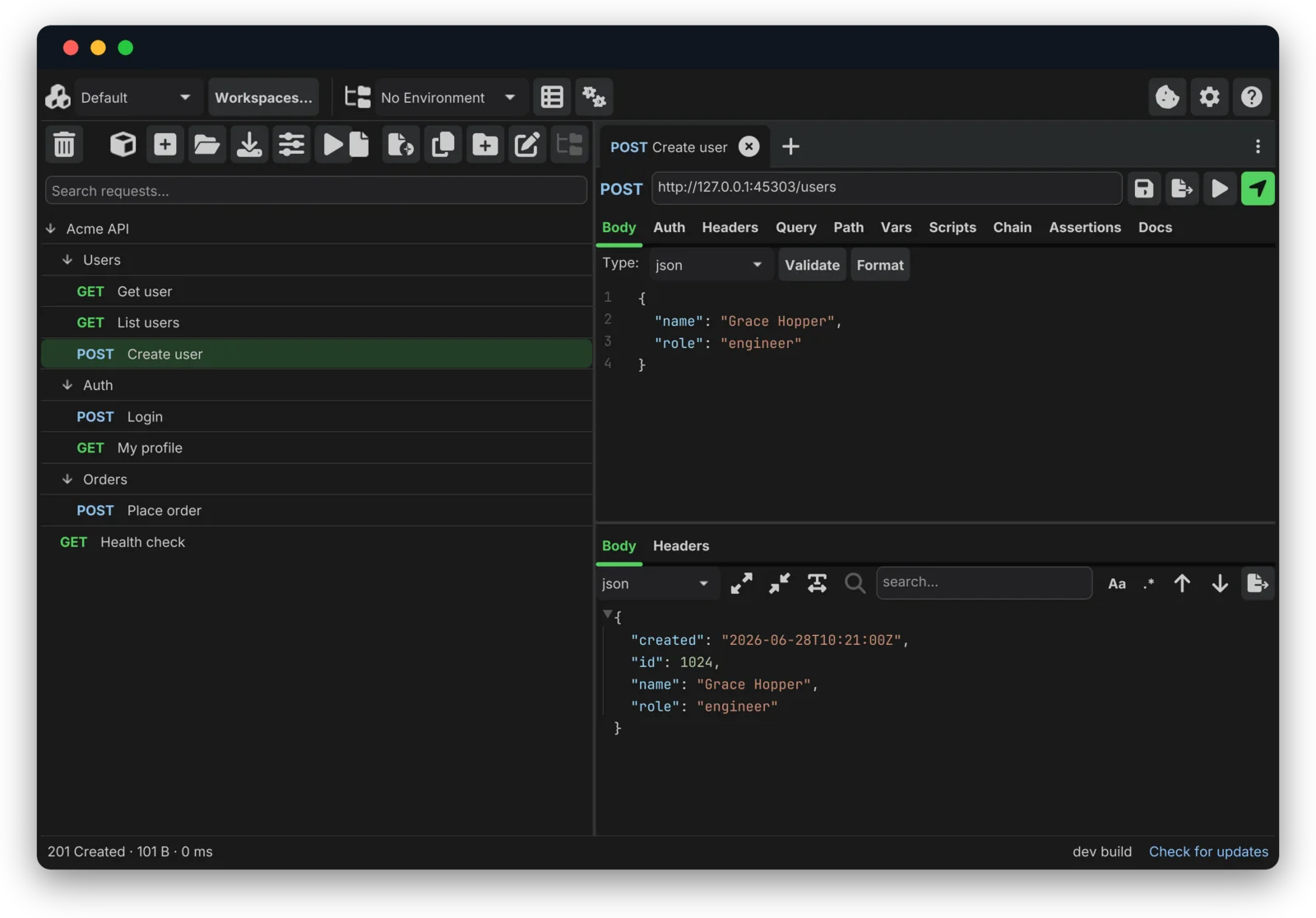
Method, URL, query params, headers, and a body that can be JSON, XML, text,
GraphQL, form-urlencoded, multipart, or a raw file. A Path tab fills the
{name} placeholders in your URL’s path (e.g. /bag/{bagId}) - no hand-editing
the raw URL - and the resolved preview shows the real target. JSON and XML get
Validate and Format buttons, and Send doubles as Abort while a request is in
flight. The
response viewer shows raw, pretty JSON, XML, and HTML (auto-detected), plus
headers, with a status line like 200 OK · 1.2 KB · 87 ms, a Save response
to file button that writes the full untruncated bytes, and a CORS advisory
when a browser would have blocked the response - checked when your request
carries an Origin header (Helena, being native, sends the request anyway).
Variables & environments
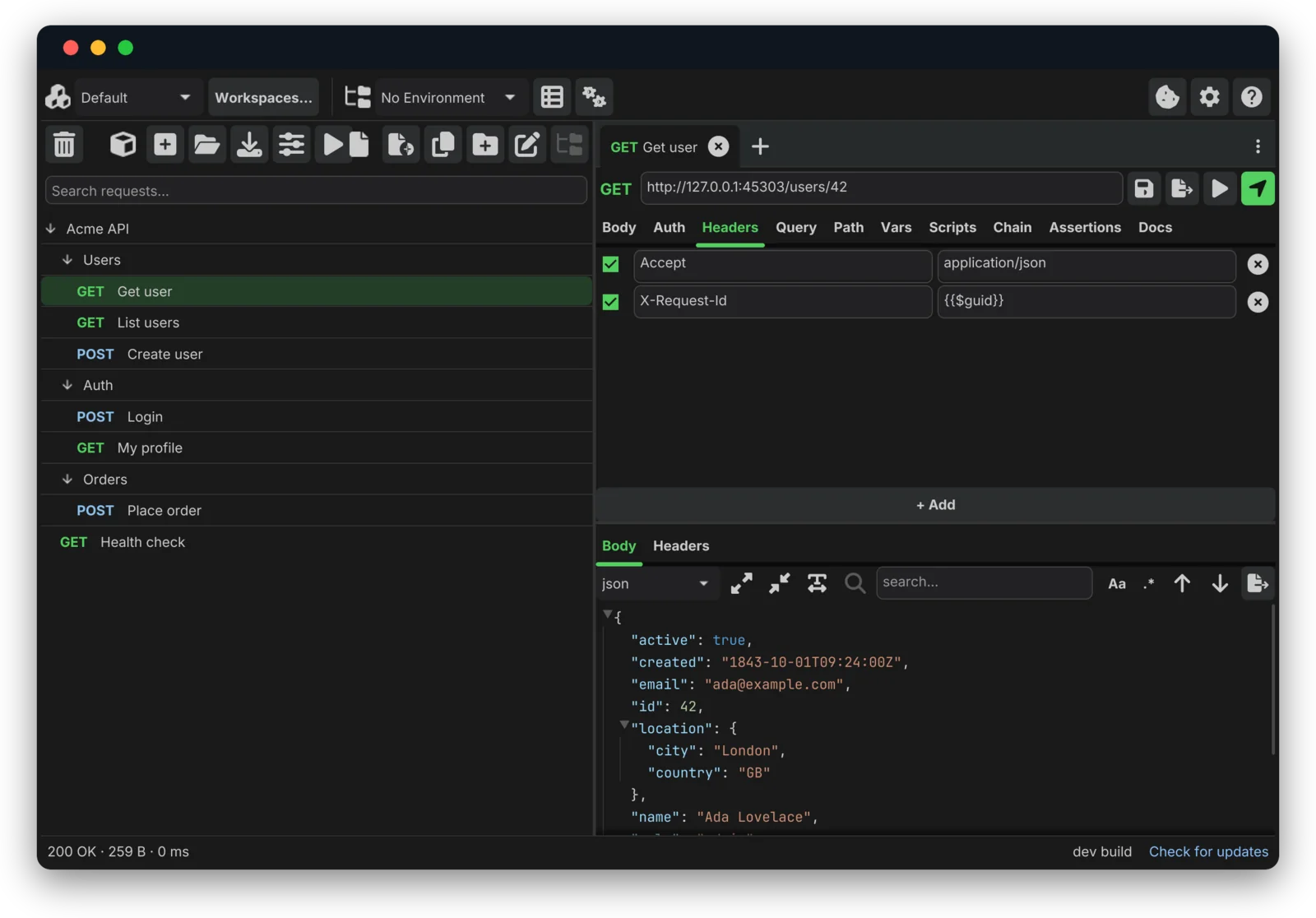
{{variable}} resolution everywhere - URL, query, headers, and body - with a
live preview of the resolved URL. Variables resolve through a layered scope
chain so the most specific value wins:
global → collection .env → collection → environment → folder → request → script overlay
Plus dynamic values like {{$guid}}, {{$timestamp}}, and ask-at-send
{{?Name}} prompt variables.
Authentication
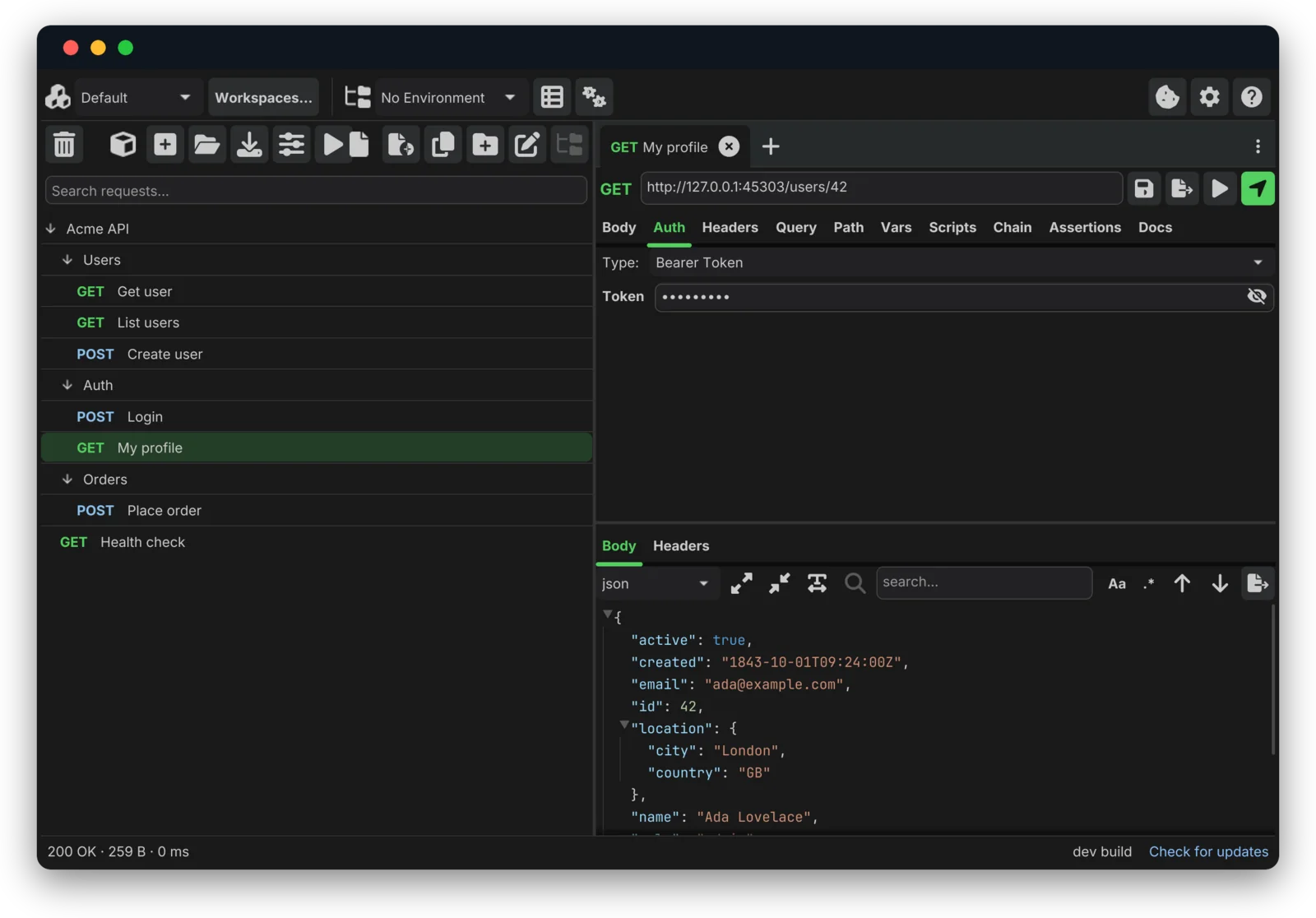
Nine schemes, all with {{var}} substitution and credentials kept out of the
committed YAML:
Basic · Bearer · API Key · OAuth 2.0 (client-credentials and authorization-code + PKCE, with token caching) · OAuth 1.0a (HMAC-SHA1) · WSSE · AWS Signature v4 · HTTP Digest (challenge/response) · NTLM (the multi-round Windows handshake).
Scripting, tests & assertions
Pre/post JavaScript hooks (via the pure-Go goja engine) with a curated
helena.* API - environment access, interpolate, sendRequest, cookie
reads, hashing, base64, uuid, date/time helpers, sleep, and headless runner
control. Verify
responses with a scripted test()/expect() framework or the no-code
Assertions tab.
Request chaining
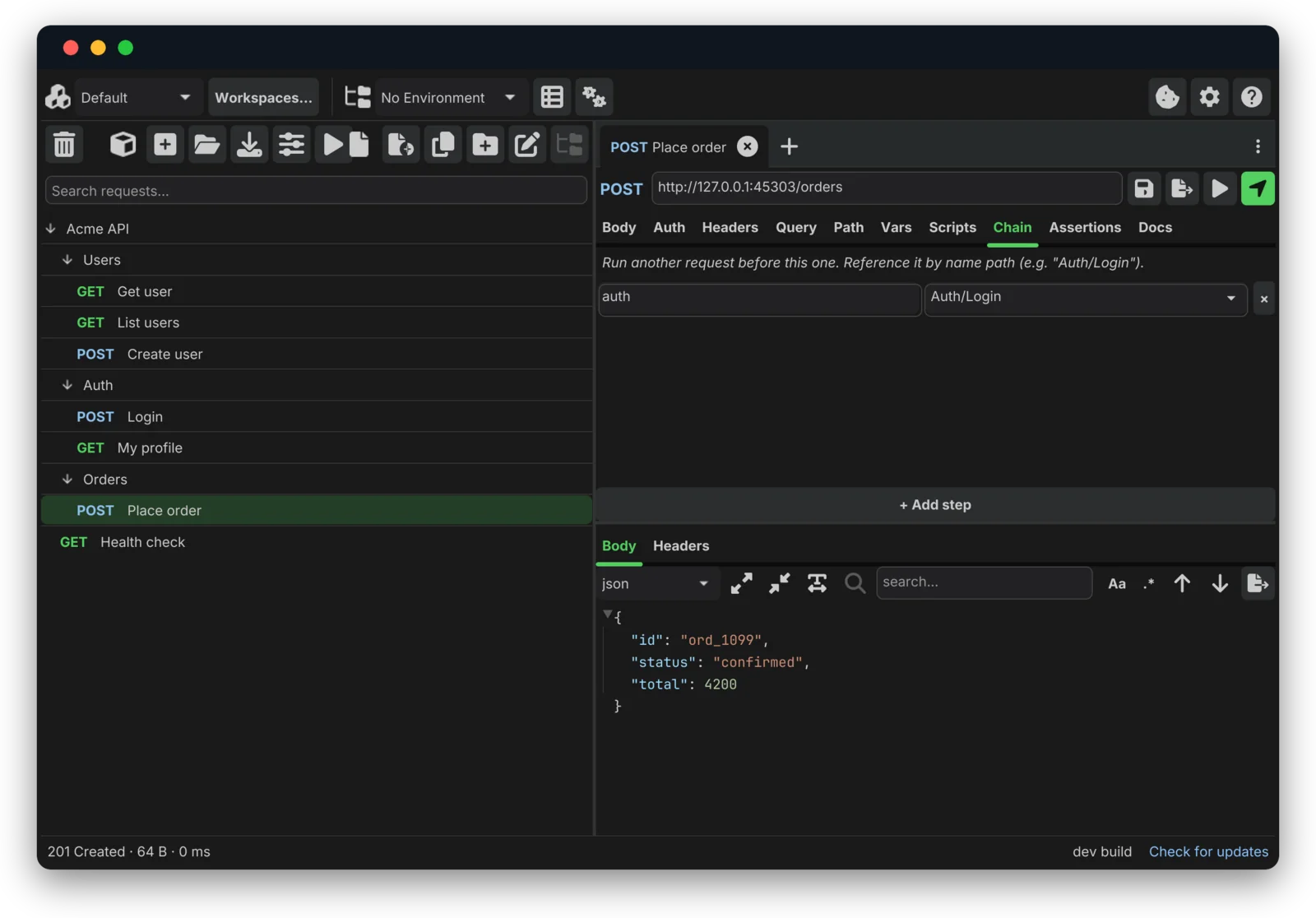
A request can declare other requests to run first; their results are bound
as chain.<alias> for the leaf’s scripts and templates - so you can log in,
then use the token, in a single Send.
Real-time - SSE & WebSocket
Stream Server-Sent Events straight into the response view, or open a
WebSocket session (ws:// / wss://) with a live two-way transcript. Both
protocols are hand-rolled on the Go standard library - no third-party network
dependency.
Collections & the headless runner
Organize requests into workspaces, collections, and folders. Run a whole
collection - or just one folder (select it and press Run, or helena run
--folder <path>) - from the GUI, or headlessly from the CLI with helena
run for CI: same resolution, scripts, and assertions as an interactive Send. It
exits non-zero on any failure and can emit a --format json or --format
junit report for CI dashboards.
Import & export
Import OpenAPI 3 / Swagger 2 / WSDL / Postman from a file or URL. Export any request to cURL, wget, JavaScript fetch, Python requests, or Go net/http, or paste a cURL command to build a request.
Storage & privacy
Collections - folders, requests, and their environments - are plain Open Collection YAML on disk; diff and merge them like source code. Auth secrets and Secret-flagged variables are externalized to a store under your OS config dir (outside the repo), so a committed collection carries no cleartext credential. The session env overlay never touches disk. Structural changes save as you make them; request edits save on Mod+S, and quitting with edits still pending asks before discarding them.
Native niceties
Light / dark / system theme, a configurable request timeout and max response size, invalid-SSL and follow-redirects toggles, a cookie jar with a viewer, request history (Help → History - restore or resend a recent send; secret-scrubbed so no credential is written to disk), drag-and-drop to reorder collections, folders, and requests in the sidebar, a status bar showing your current version with an opt-in “Check for updates” (a one-shot GitHub check only when you click it - never automatic, in keeping with the no-phone-home guarantee), and keyboard shortcuts (Mod+Enter to send, Mod+S to save, …).